

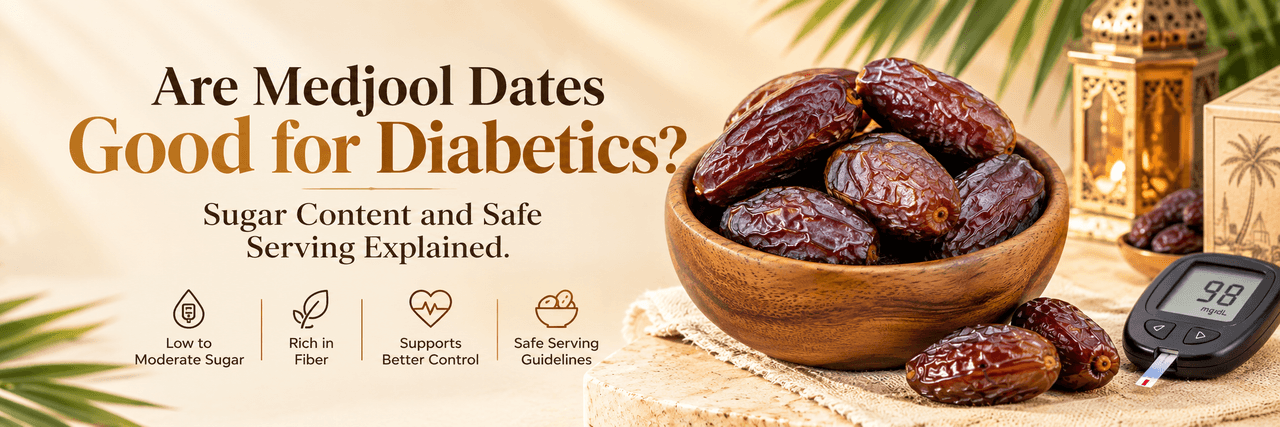
If you love the rich, caramel-like sweetness of Medjool dates but you are watching your blood sugar, you have probably asked yourself this question more than once: are Medjool dates actually safe for diabetics, or are they just sugar in disguise? The good news is that the answer is not a simple yes or no. It depends on the portion size, how you eat them, and how your body responds to natural fruit sugars. In this guide, we break down the real sugar content of Medjool dates, what the glycemic index actually tells you, and how many dates you can safely enjoy if you are managing diabetes or prediabetes.
What Makes Medjool Dates Different From Other Dates
Medjool dates are often called the king of dates because of their large size, soft texture and naturally rich sweetness. A single Medjool date weighs around 24 grams and contains roughly 16 to 18 grams of carbohydrates, most of which comes from natural sugars like fructose and glucose. That might sound high at first glance, but the full picture matters more than one number.
Unlike refined sugar, Medjool dates also carry dietary fibre, potassium, magnesium, copper and small amounts of antioxidants. This fibre content is important because it slows down how quickly sugar is absorbed into the bloodstream, which is a key reason dates behave differently from foods with the same amount of sugar but no fibre.
Medjool Dates and Blood Sugar: What the Glycemic Index Really Means
The glycemic index, or GI, measures how quickly a food raises blood sugar after eating. Foods are usually grouped as low GI (55 or below), medium GI (56 to 69) or high GI (70 and above). Most studies on Medjool and other date varieties place their GI somewhere between 40 and 55, which puts them in the low to moderate range, similar to foods like oats or apples, and lower than white bread or white rice.
This is where a lot of confusion comes from. People assume that because dates taste very sweet, they must spike blood sugar the way sugary snacks do. In reality, the fibre in dates slows digestion enough that the rise in blood sugar tends to be gradual rather than sudden, especially when dates are eaten in a sensible portion rather than by the handful.
Glycemic Index vs Glycemic Load
GI only tells part of the story. Glycemic load, or GL, factors in both the GI and the actual amount of carbohydrate in a real serving. Since Medjool dates are naturally sweet and calorie-dense, eating too many at once can still push your carbohydrate intake up quickly, even if each individual date has a moderate GI. This is why portion control matters more than the GI number alone.
How Many Medjool Dates Can a Diabetic Eat Safely
Most nutrition guidance suggests that people managing diabetes can safely include 2 to 3 Medjool dates in a day as part of a balanced diet, rather than avoiding them altogether. This amount typically keeps total carbohydrate intake from dates in a reasonable range while still allowing you to enjoy their taste and nutritional benefits.
As always, individual response to carbohydrates varies from person to person. If you have diabetes, it is worth checking your blood sugar response after eating dates and discussing portion sizes with your doctor or dietitian, especially if you are on insulin or other blood sugar medication.
Potential Benefits of Medjool Dates for People Managing Diabetes
- ✓ Rich in dietary fibre, which supports slower sugar absorption and better digestion.
- ✓ Good source of potassium and magnesium, which support heart and muscle function.
- ✓ Naturally free of added sugar, unlike many processed sweets and desserts.
- ✓ Can be used as a substitute for refined sugar in recipes, in controlled amounts.
- ✓ May help satisfy sweet cravings in a smaller, more nutrient-dense portion than some processed snacks.
Smart Ways to Eat Medjool Dates if You Have Diabetes
- ✓ Pair a date with a source of protein or healthy fat, such as a few almonds or a spoon of peanut butter, to help slow digestion.
- ✓ Stick to 1 to 3 dates per serving rather than eating them straight from a large box.
- ✓ Avoid eating dates on an empty stomach if you notice sharper blood sugar swings.
- ✓ Use chopped dates as a natural sweetener in small amounts in oats, smoothies or homemade energy bites instead of table sugar.
- ✓ Monitor your own blood sugar response, since tolerance can vary from person to person.
Choosing High Quality Medjool Dates Matters
Not all Medjool dates sold online are the same. Many imported or mass-processed dates are treated with added glucose syrup or preservatives to improve shine and shelf life, which can push up their actual sugar content beyond what is naturally present. This is an important detail for anyone managing diabetes, since the goal is to consume dates in their natural form, not a version with added sugar.
At Majestic Medjool, our dates are hand harvested and grown without chemical treatment, which means what you get is the natural sugar and fibre content of the fruit itself, with nothing artificial added. If you are choosing dates for a diabetes-friendly diet, checking that the dates are chemical-free and free from added syrup is one of the simplest ways to make a better choice.
Frequently Asked Questions
Can a diabetic eat Medjool dates every day?
In most cases, a small daily portion of 2 to 3 Medjool dates can fit into a balanced diabetic diet. It is best to monitor your blood sugar response and adjust the portion with guidance from your doctor or dietitian.
Are Medjool dates better than regular dates for diabetics?
Medjool dates are larger and slightly sweeter than varieties like Deglet Noor, but their glycemic index is in a similar low to moderate range. The main difference is portion size, since one Medjool date can contain more carbohydrate simply because it is bigger.
Do Medjool dates raise blood sugar quickly?
Because of their fibre content, Medjool dates tend to raise blood sugar more gradually than high-GI foods like white sugar or white bread, especially when eaten in moderate portions.
What is the safest way for diabetics to eat dates?
Eating a small portion alongside a protein or healthy fat, rather than on their own in large quantities, is generally considered a practical way to manage the blood sugar impact of dates.
Where can I buy pure, chemical-free Medjool dates online in India?
You can buy naturally grown, hand-harvested and chemical-free Medjool dates online from Majestic Medjool, with options for retail packs as well as bulk and gifting orders.
Final Word
Medjool dates are not necessarily off limits if you have diabetes, but like any naturally sweet food, portion size and quality matter. Choosing pure, chemical-free dates and sticking to a sensible serving can help you enjoy their taste, fibre and minerals while keeping carbohydrate intake in mind. If you are ready to try them for yourself, you can buy Medjool dates online from Majestic Medjool and explore naturally grown, hand-harvested dates.
Where to Buy Natural Medjool Dates Online
If you are looking for a convenient option, Majestic Medjool offers premium Medjool dates for online ordering in India. Check the product page for the latest price, available pack sizes, delivery options and applicable offers before placing your order.
Looking for Premium Medjool Dates Online?
Explore Majestic Medjool and check the available Medjool date products, pack sizes, pricing, delivery options and product details. Choose a quantity that suits your everyday snacking, gifting or dietary needs.